

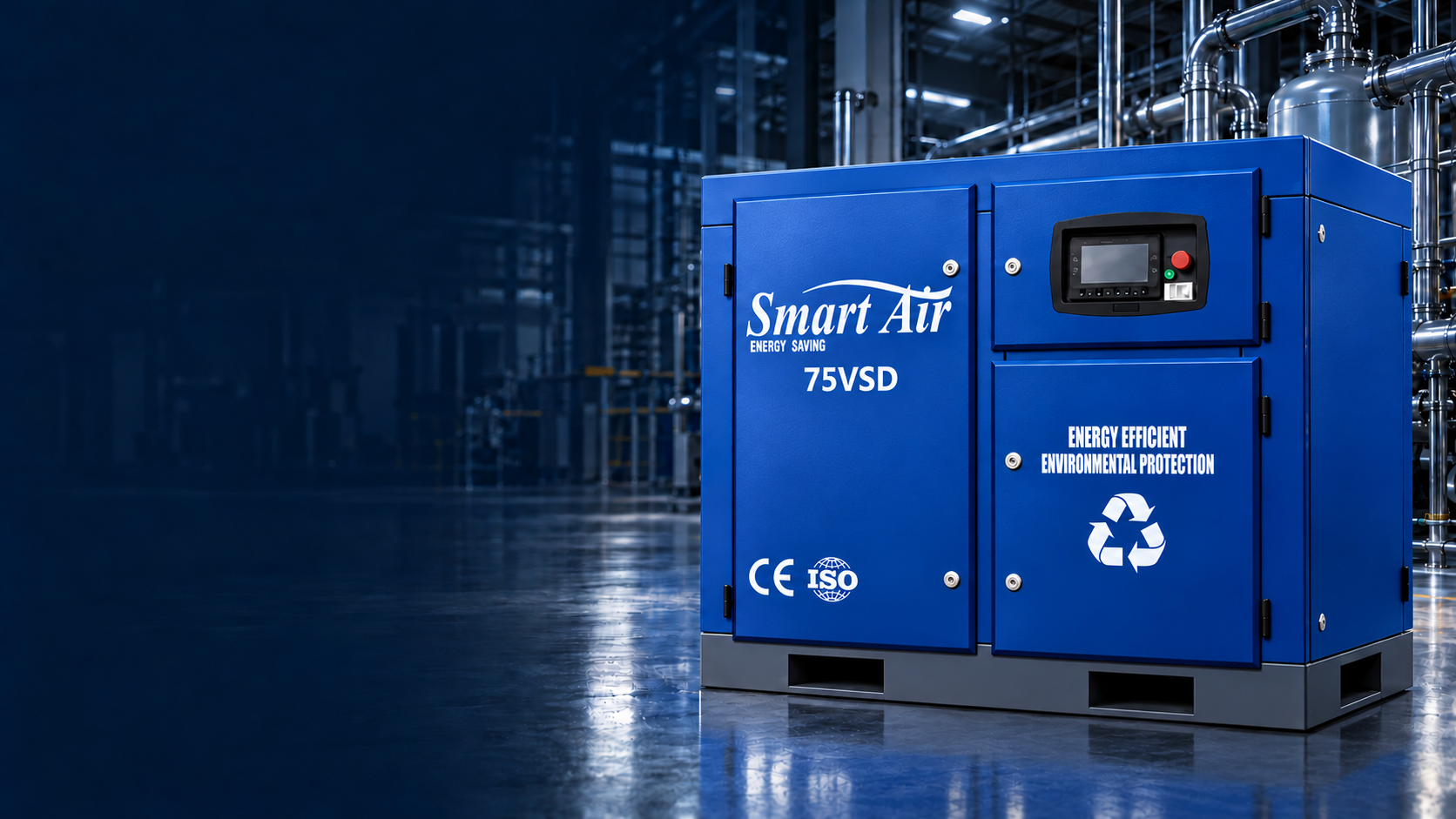
Compressed air demand changes as production machines start, stop and move between tasks. A compressor that follows those changes can use less electricity than a fixed-speed machine spending long periods unloaded. SmartAir’s PM VSD single-stage SA series combines a permanent magnet motor, variable speed control and direct drive to address this operating pattern.
Where traditional control wastes energy
A traditional fixed-speed screw compressor runs its motor at a substantially constant speed. Its controller may unload the machine or restrict intake when demand falls. During unloaded operation, the motor can continue consuming electricity while delivering no useful compressed air. The size of that loss depends on the compressor, storage volume and control settings.
Variable speed drive, or VSD, adjusts compressor speed within its operating range as demand changes. The U.S. Department of Energy identifies matching supply to demand as a central control objective. This makes the factory’s demand profile an important starting point when comparing machines. DOE: compressor control strategies.
What the permanent magnet motor contributes
PM means permanent magnet. Magnets provide the rotor’s magnetic field, avoiding the rotor excitation losses associated with induction motor operation. This can improve motor efficiency across an appropriate operating range. ABB’s technical explanation describes the wider efficiency benefits of PM synchronous motors. ABB: motor and drive technology.
The motor is one part of the package. Screw air-end performance, drive losses and operating pressure also influence electricity consumption. SmartAir’s SA series uses direct drive and inverter starting. Compare the complete compressor’s measured input power and delivered airflow when assessing an upgrade.
Match the SA model to the application
The SmartAir single-stage specification chart lists working pressures from 7 to 12 bar. For example, SA 37VSD is listed at 6.20 m³/min at 8 bar and 5.60 m³/min at 10 bar. These are different operating points, so the same motor rating does not imply identical airflow at every pressure.
Choose capacity around measured air use, peak requirements and the selected machine’s control range. An oversized compressor may spend too much time near minimum output. A plant running continuously near full capacity should compare full-load efficiency carefully: the drive introduces its own losses, so VSD does not guarantee the lowest consumption in every duty cycle. DOE: system performance sourcebook, controls section.
Turn measured power into a cost comparison
Consider an illustrative installation where monitoring shows average package power falling from 24 kW to 18 kW while equivalent production and useful air delivery are maintained. Over 6,000 operating hours, the difference is 36,000 kWh per year: 6 kW multiplied by 6,000 hours. That is a 25% reduction for this example, not a guaranteed SA-series result.
At an assumed electricity rate of PKR 50 per kWh, the energy-charge difference would be PKR 1,800,000 annually. Use the actual applicable tariff, installation cost, service costs and any demand charges when preparing a payback calculation.
Measure the result after installation
Record power, operating hours, pressure and airflow before and after the change. Keep production conditions comparable and include dryers and other treatment equipment when assessing total system consumption. These records turn an efficiency claim into a result that the factory can verify.
Share your demand measurements and pressure requirements with SmartAir to select an SA model. The strongest savings opportunity is a correctly sized machine operating with suitable storage, coordinated controls and a maintained air network.